
'/%3E%3C/svg%3E)


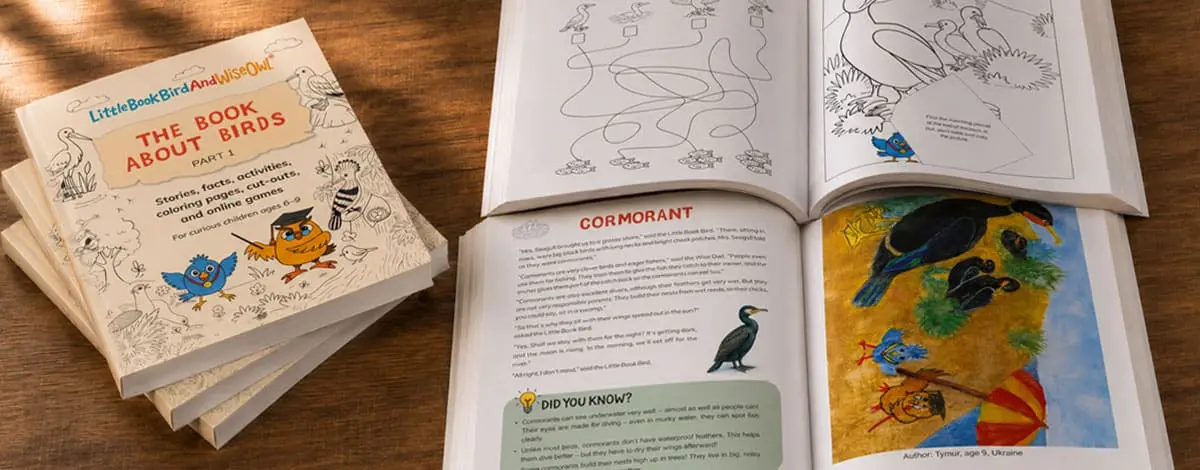
When we talk about The Book About Birds, Part 1, it is easy to assume that the book is mainly about learning facts about birds. Yes, the facts are there. But they are not presented as a simple list. They are woven into engaging stories about the first journey of the main characters: the Little Book Bird and the Wise Owl. And yet, in this book, reading is only the first step.
The printed book The Book About Birds, Part 1 was created so that a child does not simply read a story, learn a few facts, and turn the page. In this book, a child can read, look closely, notice, think, work through story-based activities, color, cut, and paste. And at the end, there is even space to create an idea for the next adventure of the main characters.
This book does not simply tell children about birds. It is a printed journey where every page invites one more small action: noticing a detail, finding a connection, completing a little task, or imagining what might happen next.
A Child Reads the Book and Travels with the Main Characters
In the book, the Little Book Bird and the Wise Owl travel through different places: fields, forests, rivers, towns, and the seashore. Along the way, they meet birds, wonder about them, ask questions, look for answers, and discover something new. That is why reading here does not feel like simply going through a list of birds. The birds do not appear separately from the story. They appear inside the journey. Each meeting has its own place, its own mood, its own little adventure, and its own discovery.
A child reads the book and gradually moves forward with the characters. The child does not simply see the name of a bird and a short fact about it. The child enters a situation where that bird becomes part of the story. In this way, knowledge does not appear on the page separately. It grows out of a living scene.
A Child Learns Bird Facts as Part of the Adventures
In The Book About Birds, Part 1, each adventure of the main characters includes real facts about birds. The facts appear where the characters need them. The Little Book Bird notices something, wonders, or does not understand. The Wise Owl explains. And then the fact is no longer dry information. It becomes an answer to a question that was born inside the adventure.
This is how a child learns about birds naturally. Not because an explanation was simply placed on the page, but because the story gave that explanation a reason to be there. In this format, birds do not remain just names. They become living participants in the journey: one may surprise, another may make the child think, and another may help the familiar world look a little more interesting and worth noticing.
A Child Observes and Notices Details
In this book, it is important not only to read, but also to notice details: in the drawings, in the activities, in the behavior of the birds, and in the way the characters react to a new meeting. Observation is a very important step, because sometimes understanding begins with a small detail. A child may notice where a bird lives, what surrounds it, what is connected with it, and how it differs from other birds. The child may return to a drawing, reread a phrase, compare a detail with an activity, or simply stay on the page a little longer.
In this way, the book encourages a slower, more attentive way of looking – a way of seeing more. Because in the world of the Little Book Bird and the Wise Owl, discoveries often begin when someone notices something.
A Child Works Through Story-Based Activities
After the stories, the book includes story-based activities. But these are not random exercises placed next to the text. They are connected with the birds, the scenes, the adventures, and the path followed by the main characters. A child does not complete an activity just for the sake of completing an activity. The child continues interacting with what has just been read.
The story-based activities help children notice, compare, choose, search, match, and complete a small action. They support attention, logic, observation, step-by-step thinking, and the ability to see connections. Most importantly, these activities do not pull the child away from the book world. They do not say, “The story is over; now comes an exercise.” They work differently: the story turns into action.
A Child Cuts, Chooses, and Pastes
The printed book The Book About Birds, Part 1 has another important part: cut-out elements. With them, a child can work with their hands: cut, choose the right place, paste, and complete part of the adventure.
This is no longer only reading with the eyes or answering in the mind. It is a practical action on the page, helping a child not just “know the answer,” but make a choice and see the result of that choice. Where should this element go? Which scene does it belong to? What does it complete?
These actions involve fine motor skills, attention, thinking, and a sense of participation. The child does not stand outside the book. The child works inside it.
A Child Colors Story-Based Coloring Pages
The book includes coloring pages created from original children’s drawings. These drawings are where the stories began – first told not in words, but through a child’s way of seeing. They show scenes from the adventures: the main characters, the bird, and the meeting place.
When a child colors a page, the child looks closely at a scene once imagined by another child: the meeting place, the bird, the main characters, the details, and the mood of the drawing. The child chooses colors, stays with the image, and makes it their own. This is another way to return to the world of the book. To the bird. To the scene. To the image that has already appeared in the journey.
It is a calm creative action. No hurry. No single right or wrong color. A child can stay on the page longer and feel that the book does not only tell a story – it also leaves space for a child’s own vision. That is why the coloring pages in this book are not just something “to fill in.” They are part of the same journey.
A Child Creates an Idea for the Next Adventure of the Main Characters
At the end of the book, there is a special page that opens the door to future adventures. On this page, a child can imagine and draw an idea for the next adventure of the Little Book Bird and the Wise Owl. Where could the characters go next? Who might they meet? What question might appear? What new adventure could be imagined?
Here, a child can suggest a direction for a future story. A child can draw an idea to show what feels interesting to them and how the book-and-game world of LittleBookBirdAndWiseOwl may continue and grow.
A Book That Does Not End After Reading
That is why The Book About Birds, Part 1 is not simply a book about birds. It is the first printed journey in the book-and-game world of LittleBookBirdAndWiseOwl. Here, a child reads and travels with the main characters, learns bird facts as part of the adventures, observes, notices details, works through story-based activities, cuts, chooses, pastes, and colors story-based coloring pages. And at the end, the child can create an idea for the next adventure of the Little Book Bird and the Wise Owl.
So reading here is only the beginning. Then the pages come alive through action, attention, creativity, and small discoveries a child makes together with the book.