
'/%3E%3C/svg%3E)


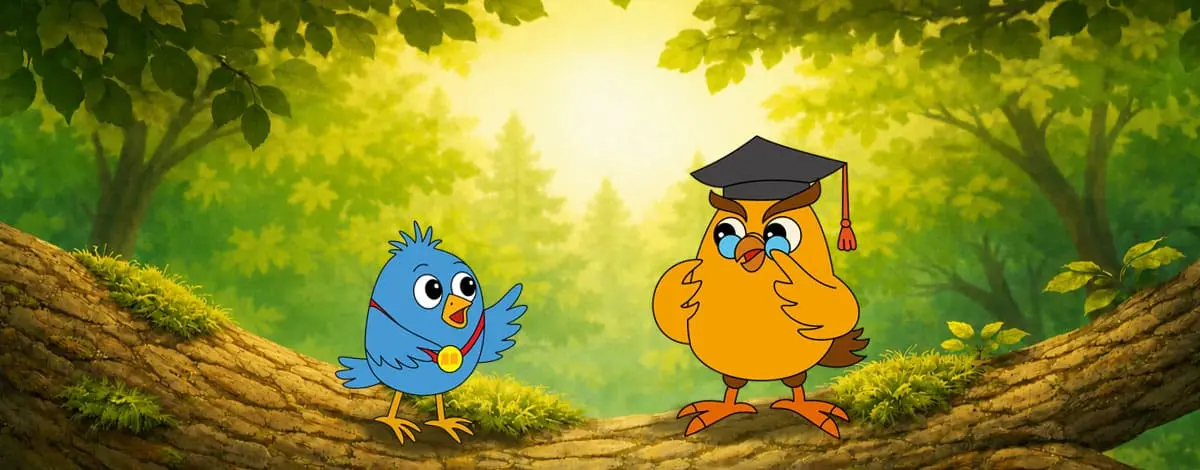
“What does ‘right’ mean?” the Little Book Bird asked the Wise Owl. “Who knows what it means? And who decides when something is ‘right’ and something is ‘wrong’? Is it written down somewhere? How can I tell when I am doing something the right way, and when I am not?”
“That is an important question. Let us try to untangle it,” the Wise Owl replied, putting on his glasses. He had only just woken up, and already the Little Book Bird had brought him a difficult question.
“There are different kinds of ‘right,’” the Wise Owl began.
“What do you mean, different?” the Little Book Bird said, looking confused. “There was one ‘right,’ and now there are many? Now it is even harder to understand!”
“Do not hurry, please. Let us look at your questions one by one,” the Wise Owl replied. “What do I mean by different kinds of ‘right’? For example, you are a bird who flies. You do not walk around on the ground on little feet. You flap your wings. For you, that is right.”
“Oh, that is so funny, Wise Owl!” the Little Book Bird laughed. “I imagined myself walking around on the ground on little feet. I would never get anywhere in time! I would not be able to visit all my friends in one day.”
“And it could be dangerous for you too, because your little feet would not manage to hide you from predators,” the Wise Owl added. “Now tell me, why do you flap your wings in this way and not in another?”
“Because that is right,” the Little Book Bird said, surprised.
“Exactly. For a bird like you, it is the only right way.”
“Here is another example,” he continued. “When you play online puzzle games, you put the picture together by looking at the image. Someone else might build the same puzzle row by row, column by column, or in some other way. Each player may have their own ‘right.’ Here, there is not one single right path to the result. Everyone follows their own way, the way that feels right for them. Some make more mistakes, some fewer. Some learn from them, and some do not. Those who learn from their mistakes often move faster next time, while the others make the same mistakes again. But everyone has their own pace and their own ‘right’ way.”
“So this kind of ‘right’ is something I can find for myself?” the Little Book Bird asked.
“More or less. But your ‘right’ must not harm others. There is also another kind of ‘right,’ the one that is the same for everyone. For example, you know that in the forest, most birds sleep at night. What would happen if you and I started flying all over the forest at night, shouting loudly and making noise?” the Wise Owl asked.
“Oh! That would not be good. Everyone would wake up and get frightened,” the Little Book Bird replied.
“Would our actions be right or not?”
“Of course not. That would be wrong!”
“You see? You already understand what is right for everyone and what is not. There is not always one single right path. At the same time, some ways are already known to be right because someone once found a way or walked a path, tested it, and understood: sometimes it is the only way, sometimes it is safer, and sometimes it simply leads more reliably to where we need to go.”
“And none of our ‘right ways’ should harm others,” the Little Book Bird added.